Stress-Free Dog Walks: 3 Concrete Tips

Stress-free walks with your dog come down to three things you can start doing today: give him one walk a day of free sniffing time, do a treat scatter along the way, and swap the short leash for a fixed leash of at least 10 feet (3 meters). Walking politely on a leash is one of the hardest things we ask of a dog, and most walking problems (pulling, refusing to move, barking at everything) do not come from stubbornness but from tension. These three tips take that tension out. I wrote this article in 2020 after yet another dog owner told me the walk had turned into a fight; since then more than 30,000 dog parents have taken a Stressless Dogs course.
In short
Walking along on a leash is a demanding task for a dog: he has to suppress his natural behavior and pay attention to you the entire time.
Freedom of choice is good for mental health, in people and in dogs. Give your dog control where it is safe to do so.
Tip 1: free sniffing time. Tip 2: the treat scatter. Tip 3: a fixed leash of at least 10 feet (3 meters).
Sniffing is measurably calming: the heart rate goes down.
Pulling on the leash is in many cases caused by a leash that is too short.
Do you also want to see what your dog is telling you along the way? Watch the free webinar.
Look at it from the other side
Have you ever stopped to think about how hard it is for a dog to “walk nicely”? He is attached to someone else who has the control, that person decides where you go, he has to keep watching so the leash does not go tight, he cannot move freely and cannot make his own choices. Dogs are curious by nature and follow their nose; walking along on a leash means he has to ignore that natural behavior and constantly adapt to your pace and your direction. That is asking a great deal.
Of course we cannot simply walk along behind a dog all the time. You are the one leading, you are the one keeping things safe. But there are plenty of moments where your dog can make a choice of his own, and too little freedom of choice is bad for wellbeing: making your own choices lets self-reliance and confidence grow. It is give and take, the same as with your friends and your children.
The three tips
Tip | What you do | Why it works |
|---|---|---|
1. Free sniffing time | Turn one walk a day into a walk with no route: fifteen minutes in which your dog can sniff for as long as he wants | Sniffing is the single most important reason for the walk from your dog’s point of view, and it lowers the heart rate |
2. Treat scatter | In a quiet spot, scatter a handful of small treats over about five square feet (half a square meter) and let him search | Nose work is calming, it is satisfying, and it links walking with you to something good |
3. The long leash | A fixed, lightweight leash of at least 10 feet (3 meters), not a retractable one | On a short leash the leash is tight most of the time; 10 feet is the length at which a dog can move normally and relax |
In summary: the three tips are free sniffing time (one walk a day with no route, in which your dog decides where you go), the treat scatter (scattering a handful of small treats in a quiet spot, because nose work is calming) and the long leash (a fixed, lightweight leash of at least 10 feet and no retractable leash, because on a short leash the leash is tight most of the time).
Tip 1: free sniffing time
Turn one walk a day into a walk where your dog can sniff for as long as he wants. The trick is to let go of the route: decide in advance that there is no route, and no tidy loop either. Instead of a distance, take a length of time as your goal, fifteen minutes for example. Does your dog choose to sniff a shrub on the corner for ten minutes? Then you did not make it off your own street on that walk, and as far as your dog is concerned that is completely fine. Sniffing matters so much to him that the walking part can take a back seat for once.

You can also build a stretch of free sniffing time into a longer walk: the first or the last twenty minutes. Choose quiet, open spots where you can see what is coming, like an office park outside business hours, where your dog has all the time he needs to wander and choose.
Tip 2: the treat scatter
On some walks, bring a bag of small treats your dog can swallow in one bite. Pick a place and a moment when it is quiet: no other dogs or people within about 15 feet (5 meters), no traffic nearby. Then you do a treat scatter, a simple form of nose work in which your dog gets to show his natural behavior:
Take about five small treats in your hand.
Scatter them calmly on the ground with a low hand, over a small area of about five square feet (half a square meter).
Step back and let your dog search and nibble on his own.
Keep the leash loose: hold it at the very end so your dog has room.
If it goes well and he enjoys it, use slightly more treats and a larger area each time. Vary the surface: grass, pavement, gravel.
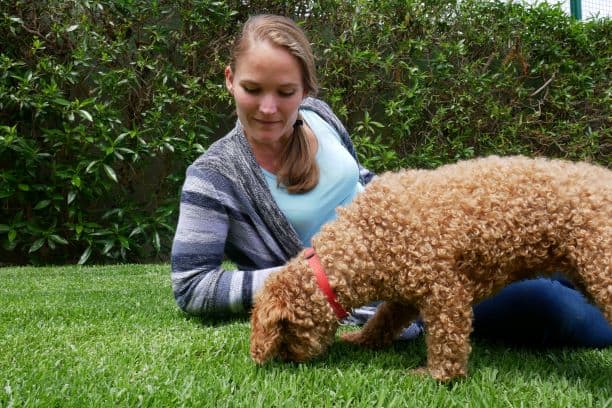
Tracking down the treats and eating them has a calming effect and is deeply satisfying. And your dog builds a positive association with walking alongside you. Only do this when he has something in his stomach already, and for dogs who are often tense outdoors: practice at home and in the yard first.
Tip 3: the secret of the long leash
Use a fixed leash of at least 10 feet (3 meters), made of a light material such as nylon or biothane, ideally without rattling metal hooks and rings. A fixed leash of at least 10 feet (so not a retractable one) is a real relief for your dog. A leash that is too short means tension builds up quickly and your dog cannot move freely; with a leash of 6 feet (2 meters) or less it is very hard for a dog to relax while walking. Pulling on the leash is in many cases caused by a leash that is too short, and with a 10-foot leash the problem is often mostly solved. A long leash reduces tension, and less tension means less pulling.
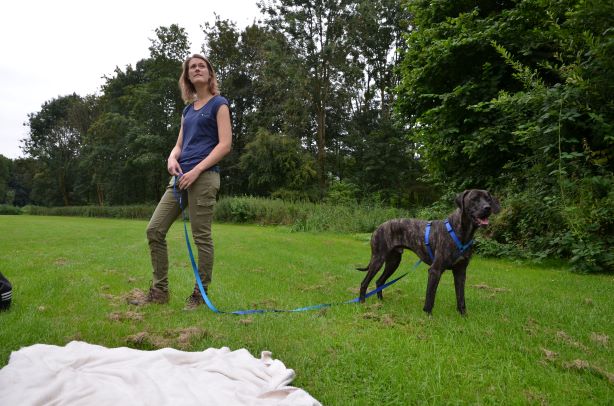
That is not a feeling but something measurable: in the French Dog Field Study by Cristina and Aurelien Budzinski, with 61 dogs, dogs on a 16-foot (5 meter) leash sniffed almost three times as long as on a short leash of 5 feet (1.5 meters), and almost as long as off leash, and the more intensely they sniffed, the lower their heart rate. Combine the leash with a well-fitting Y-harness; which harness and which leash width suits your dog is covered in Dog Harness vs Collar.
From our practice
W. G. wrote on Trustpilot (July 30, 2026, 5 stars): “The videos are also very helpful for seeing the communication dogs show, which we as humans can miss. Once you start walking with your dog consciously, you notice more than you expect.”
That is exactly what the three tips do: as soon as your dog is given the room to sniff and to choose, you suddenly see how much he is telling you along the way.
When to get help
If your dog still pulls hard despite a long leash and sniffing time, something underneath is probably playing up: stress, arousal, pain, or fear of corrections he got in the past. Which of the three causes applies to your dog is covered in Why Does My Dog Pull on the Leash?. If he lunges at dogs, cyclists or people, then prevention and distance are the first step and guidance is often needed; with any sudden change in behavior, always have your veterinarian take a look.
Frequently asked questions
How long and how often should I walk my puppy?
Much shorter and much calmer than most people think. Up to about twelve weeks you are not really walking at all: you let your puppy look around and sniff on the leash in safe places. After that you build up slowly, as we explain in how long can you walk a puppy? Standing still and watching is more important for a young dog than covering distance.
Can my dog sniff everywhere? I want him to keep walking politely.
Sniffing is the single most important reason for the walk from your dog’s point of view. It is about balance: at some moments he gets to sniff and choose, at other moments you ask him with your body and the leash to walk along with you. On top of that, schedule real sniff walks.
What do I do if my dog does not want to stand still or keeps wanting to go somewhere?
An enormous amount happens outdoors for a dog, and he needs time to look and to process. Give him that time in a safe spot and do not drag him along, unless safety really requires it.
Does this also work with an older dog who has been pulling for years?
Yes, although unlearning pulling in an adult dog usually takes more time than in a puppy. Start with the long leash and the sniff walks; taking the tension out is the first step, technique comes after that.
Sources
Budzinski, C. and A. Dog Field Study, pulse study “At the heart of the walk”: 61 dogs, short leash versus long leash versus off leash; sniffing time and heart rate measured.
Read next
How to Recognize Stress in Your Dog: The Signals Almost Everyone Misses
Dog walking equipment compared: harness, collar, head halter and more
From a walk to a conversation
As soon as your dog gets the room to sniff and to choose, you see how much he says along the way: a nose that goes to the ground when another dog approaches, a body that slows down for a cyclist, a look that lingers for a moment. In the free webinar Communicating With Your Dog you learn to read those signals and a technique for guiding your dog without the leash and without your voice.
Do you want to turn every walk into the best moment of the day, including leash handling, the harness and lowering stress? That is what the Stressless Communication Course is for.
Thank you for reading, on behalf of me and all the dogs.
Dog Behavior Consultant & Natural Dog Trainer