Harness or collar: which is better for your dog?

A Y-shaped harness is better than a collar, as long as it is well designed and fits properly. On a collar, all the force from the leash lands on the neck, and a dog’s neck is just as vulnerable as ours: that is where the windpipe, the thyroid gland and the neck vertebrae are. A good Y-shaped harness, named for the Y the straps form at the front, spreads any pulling force over the strong ribcage and leaves the shoulder joint free. But not every harness with a Y on the label is a good harness: a harness with a horizontal chest strap pinches the front legs together like a pencil skirt, and a harness with the ring at the front of the neck does exactly what a collar does. And the harness is only half the story. The other half is a fixed leash of at least 10 feet (3 meters).
In short
Collars, choke chains, head halters, prong collars and no-pull harnesses with a horizontal chest strap: all of them are best avoided. They load the neck or restrict natural movement, they raise stress, and they make problem behavior bigger.
You recognize a good Y-shaped harness by the ring on the back panel and the Y shape at the front: three straps meet at the sternum.
Fit: two fingers of room at the armpit, a hand that slides underneath, the meeting point on the sternum.
Combine it with a fixed leash of at least 10 feet (3 meters). No retractable leash.
If your dog finds the harness scary, do not force it: build it up in small steps, and keep the collar for the time being if you have to.
Only on a good harness and a long leash do you get to see what your dog is telling you along the way. Learn to read it in the free webinar.
Why not a collar?
Dogs have no collarbone. The shoulder blade floats and moves while they walk, and the neck is a vulnerable area holding organs, the windpipe and the thyroid gland. Catching pulling force on the neck causes injuries. In a dog who lunges on leash, the force is so large that the thyroid gland, the neck vertebrae and the windpipe can be damaged, and the neck pain that follows keeps the lunging going. Compare it to a seat belt around your neck instead of across your chest. That is why we advise against the collar, the choke chain, the head halter or gentle leader, the prong collar and every no-pull harness with a horizontal chest strap. They cause pain or restrict movement, they raise stress, and a stressed dog pulls and reacts more, not less.
Good harness, bad harness
Feature | A good Y-shaped harness | Best avoided |
|---|---|---|
Shape at the front | Y shape: three straps meet at the sternum | A horizontal chest strap across the shoulders (pinches off the front leg movement), even if the label says “Y” |
Where the leash attaches | To the ring on the back panel | A ring at the front on the neck (works like a collar) |
The shoulder joint | Stays free: the straps run around the shoulder | Straps across the shoulder blade |
Where the force lands | On the ribcage, the strongest part of the body | On the neck, the windpipe and the thyroid gland |
Buckles | Two, or four for dogs who do not want anything over their head | Anything that has to go over the head of a dog who finds that frightening |
For a puppy | A harness with an exchange program, because he grows so fast | A collar or a choke chain |
In summary: a good Y-shaped harness has a Y at the front with three straps meeting at the sternum, the leash on the ring on the back panel, a free shoulder joint, the force landing on the ribcage, two or four buckles, and for a puppy an exchange program. Best avoided are a horizontal chest strap across the shoulders, a ring at the front on the neck, straps across the shoulder blade, anything that has to go over the head of a dog who finds that frightening, and for a puppy a collar or a choke chain.
Variations: with padding or bedding (nice for a bare belly or sensitive skin, but it is a double layer of material and it goes over the head) or with four buckles (does not have to go over the head, which is helpful for dogs who dislike that).
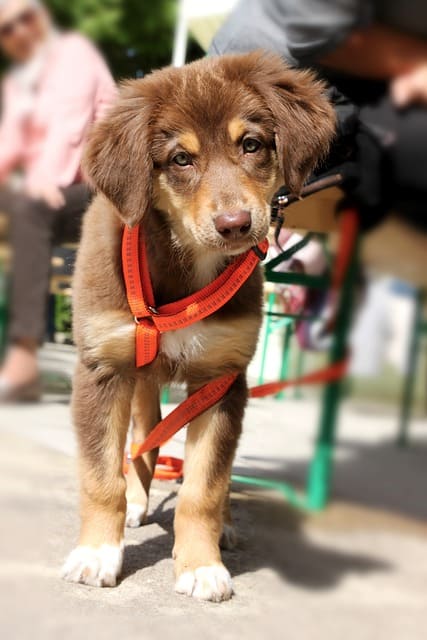
How to check the fit
The armpit. The rear strap does not sit in the armpit. Rule of thumb: at least two fingers of room, one finger for very small dogs.
Not too tight. You can slide a hand under the harness; the ribcage moves when your dog breathes.
The sternum. The point where the straps meet sits on the sternum, which you can feel as a small bump.
The leash on the back. You clip the leash to the ring on the back, not at the neck.
The leash is the other half
A fixed leash of at least 10 feet (3 meters), not a retractable leash. Ten feet is the length a dog needs to move naturally and relax; against expectation, a dog pulls less on a longer leash, because he is not constantly running into the end of it. In the French Dog Field Study by Cristina and Aurélien Budzinski, with 61 dogs, dogs on a 16 foot (5 meter) leash sniffed almost three times as long as on a short 5 foot (1.5 meter) leash, and almost as long as when they were off leash. And the more intensely they sniffed, the lower their heart rate. Sixteen feet (5 meters) is fine, 33 feet (10 meters) for nature areas; anything longer than 16 feet (5 meters) in town takes more handling skill.
No retractable leash: the noise, the unpredictable abrupt stop with a jolt on the body, and the handle that shoots after the dog if you drop it. On top of that, a retractable leash is always under tension, and then you cannot communicate through it.
Your dog’s weight | Width of the leash |
|---|---|
Up to 18 lbs (8 kg) | 0.4 inches (1 cm) |
Up to 33 lbs (15 kg) | 0.6 inches (1.5 cm) |
33 to 66 lbs (15 to 30 kg) | 0.8 inches (2 cm) |
Over 66 lbs (30 kg) | 1 to 1.2 inches (2.5 to 3 cm) |
In summary: choose the leash width based on your dog’s weight: up to 18 lbs (8 kg) go for 0.4 inches (1 cm), up to 33 lbs (15 kg) 0.6 inches (1.5 cm), from 33 to 66 lbs (15 to 30 kg) 0.8 inches (2 cm), and over 66 lbs (30 kg) 1 to 1.2 inches (2.5 to 3 cm).
Material: nylon (strong, with rubber woven in for grip), biothane (does not absorb moisture) or leather (heavy). Too wide is also bad: too heavy, especially for small dogs. As few rings and clips as possible, and a good quality snap hook, because the leash is the seat belt. Why a short leash actively invites pulling is explained in The 3 reasons why a dog pulls on the leash.
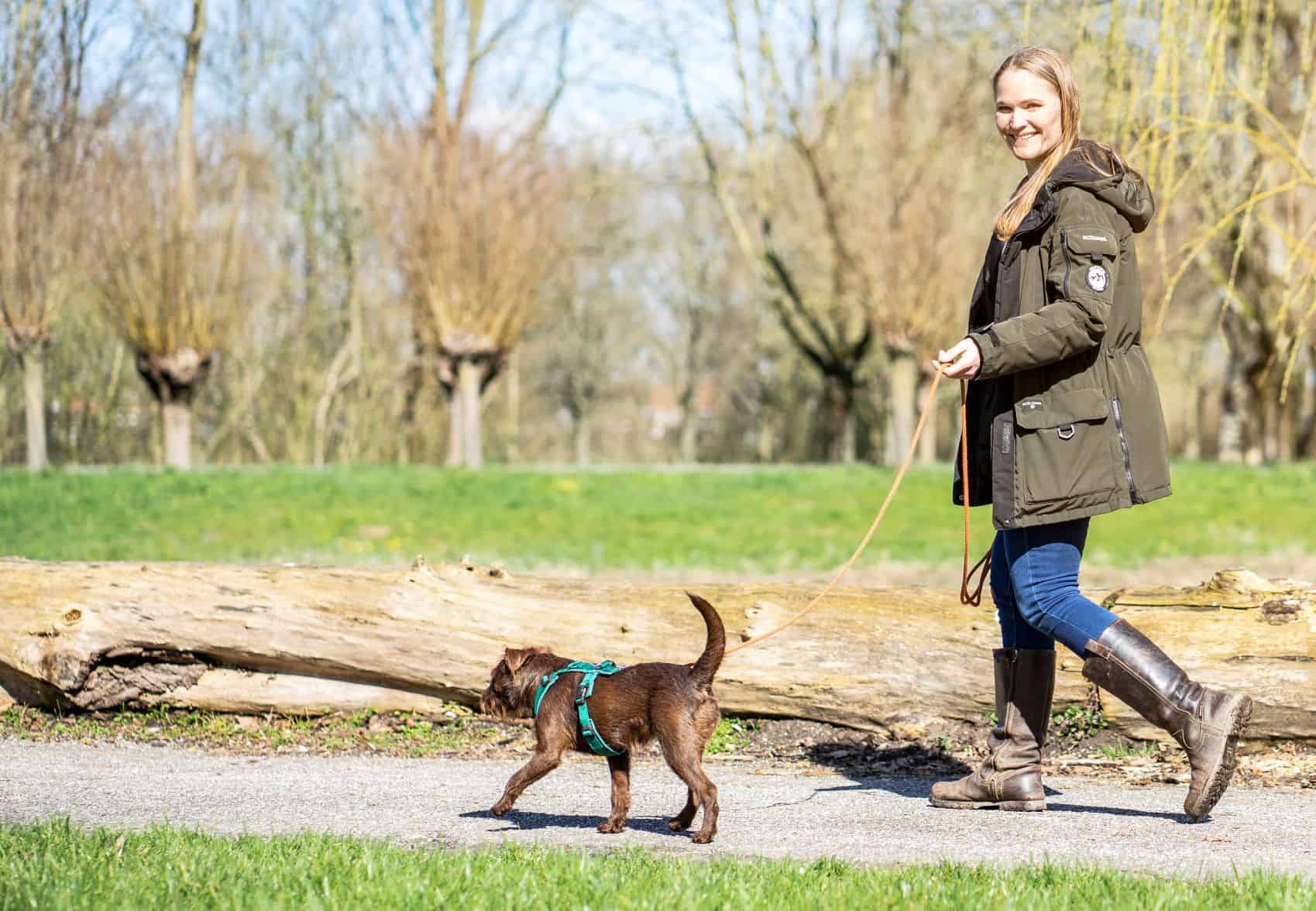
Does your dog find the harness scary?
Putting the harness on is a tense moment: you come deep into your dog’s personal space and you quickly end up leaning over him, which in dog language is imposing and rude. So sit on the floor or crouch, move calmly with low arms from underneath, and let your dog sniff the harness first. Put the harness down and let him come to you instead of the other way around, and reward him for coming. All buckles from underneath, never reaching over the head.
With real fear of the harness, you work at home in small steps and you keep the collar for the time being, however good the harness is. Forcing it turns the harness itself into something frightening, and that is the last thing you want.
From our practice
K. wrote on Trustpilot (July 21, 2026, 5 stars): “Two weeks into the course now. Bought a harness and a 10 foot leash and what a difference we notice on our walks, so relaxed, so happy with it! And to think how much we shortchanged our dog all those years […]”
And gj h. (February 28, 2026, 5 stars) on putting the harness on: “I already had a good bond with my dog, but now I understand her body language even better, for example when putting on the leash or the harness […]”
Frequently asked questions
Ten feet sounds far too long. Will my dog not pull more?
It is exactly the other way around. On a short leash the dog is constantly at the end of it and learns to pull; that creates continuous tension. Ten feet is the length a dog needs to move normally and relax, and a relaxed dog pulls less. Bring your old leash along in the beginning just in case.
My dog pulls hard. Is a no-pull harness not better?
No. A no-pull harness with a horizontal chest strap restricts movement and raises stress, and pulling is usually the result of tension and a leash that is too short, not of the harness. Address the cause; tips for that are in Stress free dog walks: 3 concrete tips.
Can a puppy wear a harness already?
Yes, from the start, with an exchange program because of the growth. No collar and no choke chain, and a light leash of 8 to 10 feet (2.5 to 3 meters), never 3 feet (1 meter).
My dog lunges on leash. Does the harness make a difference?
A large one. The force of a lunge on a collar can damage the thyroid gland, the neck vertebrae and the windpipe, and neck pain then keeps the lunging going. A well fitting Y-shaped harness catches the force across the body. More about lunging in Why does my dog lunge at other dogs?
Sources
Budzinski, C. and A. Dog Field Study, pulse study “At the heart of the walk”: 61 dogs, five minutes on a 5 foot (1.5 meter) leash, five minutes on a 16 foot (5 meter) leash and five minutes off leash; sniffing time and heart rate measured.
Lafuente, M.P., Provis, L. and Schmalz, E.A. (2019). Effects of restrictive and non-restrictive harnesses on shoulder extension in dogs at walk and trot. Veterinary Record, 184, 64. Harnesses with a strap across the shoulder limit the extension of the front leg.
Carter, A., McNally, D. and Roshier, A. (2020). Canine collars: an investigation of collar type and the forces applied to a simulated neck model. Veterinary Record, 187. On the forces collars exert on the neck during a jerk.
American Kennel Club. Dog Harness vs. Collar. A general comparison of harnesses and collars.
Read next
Harness, collar, head halter, choke chain or no-pull harness: the overview
Dog walking equipment compared: harness, collar, head halter and more
The harness changes the walk, you change the conversation
A dog in a good harness on a long leash can finally move normally, and only then do you see everything he is telling you along the way: a nose that drops to the ground as another dog approaches, a body that slows down, a stare that lingers. In our free webinar on communicating with your dog you learn to read those signals and a technique to guide your dog without the leash and without your voice.
Do you want to turn every walk into the best moment of the day, starting with reading what your dog says long before the leash goes tight? That is the Stressless Communication Course. More than 30,000 dog parents have taken a Stressless Dogs course.
Everything we teach sits in one place: you can find all of our courses and the community there, and the free webinar is the easiest way in.
Thank you for reading, on behalf of me and all the dogs.
Dog Behavior Consultant & Natural Dog Trainer