Dog Body Language: How to Read What Your Dog Is Saying

Dog body language is the whole conversation: dogs talk all day long with their head, their eyes, their body and their pace, and almost never with sound. Once you can read the language, you see that a dog first asks politely (looking away, slowing down, walking a curve), then shows tension (lip licking, yawning, whale eye, freezing) and only becomes loud as a last resort (growling, barking, snapping). We usually miss the first two steps, and in dog language we are the rude party ourselves: we walk straight at dogs, we stare, we reach over their heads and we talk. This article is the foundation. It lays out the four groups of signals, shows how the ladder from quiet to loud works, and gives you the six techniques to talk back without using your voice.
In short
Behavior is communication. The first question is always “what is my dog telling me?”, never “how do I stop this?”.
Dogs are polite and conflict avoiding by nature. Fighting is expensive, so they always start quietly.
Communication escalates. Growling and biting never come out of nowhere. We simply miss the signals that came first.
We are the clumsy conversation partner. The adjustment is ours to make, not the dog’s.
You answer with your body: slowing down, turning your side, curving, splitting, a low open hand.
Would you rather see the language than read about it? The free webinar with Jess shows the five most commonly missed signals on video.
Why dog language is the beginning of everything
Almost every behavior we find difficult (pulling, barking, lunging, biting, not being able to stay alone) is the end of a conversation the dog started much earlier. A dog who lunges at another dog first slowed down, sniffed, looked away and gave a small lip lick. A puppy who bites first got overexcited and yawned. A dog who growls while being petted first turned his head away. If you read the opening lines, you never have to hear the closing ones. That is the reason every Stressless Dogs course begins with dog language.
The other insight is less comfortable: in dog language, we are often rude. Walking straight at a dog, looking him in the eye, reaching over his head and talking to him is, to a dog, the behavior of a stressed, socially clumsy teenager. It is often exactly the people who love dogs most who do this without realizing it. That is nobody’s fault: nobody is born knowing dog language. When we knew better, we started doing better.
The four groups of signals
Group | Examples | What the dog is saying | What you do |
|---|---|---|---|
Calming signals (more than thirty of them, described by Turid Rugaas) | Lip licking, yawning, turning the head away, looking away, slowing down, sitting down, curving, suddenly sniffing, showing the side of the body, the play bow | “I am not looking for a fight.” Politeness, also in relaxed situations. | Let him, and do the same thing back. |
Stress signals | Whale eye, ears pinned back, tight muzzle, freezing, lifting a paw, scratching without an itch, panting when it is not hot, shaking off | “This is becoming too much for me.” The bucket is filling up. | Create distance, remove the trigger. |
Fear signals | Ears flat, tail tucked between the legs, low crouched posture, shaking, crawling, leaking urine, dilated pupils, freezing | “I am scared.” Often mistaken for guilt; the dog is afraid of your reaction. | Take him out of the situation, support him, never punish. |
Distance increasing signals | Showing teeth, growling, snapping, lunging, hard staring | “Stop. Now.” This is the dog shouting, and the last warning before a bite. | Stop what you are doing and increase the distance. Never correct. |
In summary: calming signals (lip licking, yawning, looking away, slowing down) mean “I am not looking for a fight” and you answer them by doing the same thing; stress signals (whale eye, ears pinned back, freezing, lifting a paw) mean “this is becoming too much for me” and ask for distance; fear signals (ears flat, tail tucked, shaking) mean “I am scared” and ask for support without punishment; distance increasing signals (showing teeth, growling, snapping, lunging) mean “stop, now” and ask you to stop and move away.
The calming signals are worked out in detail in Calming signals in dogs, the way stress builds up in Signs of stress in dogs, and growling in Why does my dog growl?
The ladder: from quiet to loud
Dogs open quietly and non-verbally. Barking, whining and growling mean the quiet phase was not heard. On the ladder it goes like this: first a calming signal (looking away), then a stronger signal (slowing down, yawning), then stress (freezing, whale eye), then a warning (growling, showing teeth) and only then a snap or a bite. The more often a dog experiences that the quiet signals make no difference, the faster he skips the first rungs. A dog who gets punished for growling even learns to skip the warning. That is why you never punish a signal.
Two things to always read separately: the emotion and the level of arousal. A wagging tail means arousal, not happiness. Arousal can be positive or negative, and in both cases it puts the thinking brain on pause. A dog who “goes completely wild” when visitors arrive is not happy; he is discharging tension.
Why dominance has nothing to do with it
A lot of old advice assumes your dog is trying to be the boss and that you have to be the “alpha”. That idea comes from research on captive wolves in the 1950s and 1960s: unrelated adult animals put together, who did indeed fight over rank. David Mech, the researcher who popularized the term alpha, distanced himself from it in 1999: a group of wolves in the wild is a family, parents with their young, in which the parents care and guide without fighting. Dogs live the same way: in families, with caring adults. A dog who listens when you act dominant does so because he avoids conflict and adapts, not because you proved anything. That does not make you a leader, it makes you bossy.
Talking back: the six techniques
You can speak exactly the same language. These are the techniques from the Stressless Communication Course, all variations on one idea: say it with your body.
Technique | What you do | When |
|---|---|---|
Curving | Walking toward a dog, a person or a trigger in a curve instead of a straight line; your body turned a quarter away, no eye contact. | Every encounter. Not curving is the single biggest cause of lunging on the leash. |
Splitting | Calmly stepping in between your dog and the trigger, your side toward your dog, palms facing him, without saying anything. Before the reaction, not after. | Visitors, other dogs, children who come too close. |
Turning away | Removing attention: first your head, then your body, then a step away. No “no”, no hands in the air. | Jumping up and other behavior aimed at you. |
Deliberately not responding | Not looking, not talking, not touching, and rewarding the alternative. Not for fearful, sick, very young or old dogs, and not for self-rewarding behavior. | Attention seeking without an underlying need. |
The hand signal | A low, loosely opened hand with the palm toward the dog, without eye contact. Teach it first in calm moments, no more than six repetitions at a time. | “I am handling this, you do not have to do anything.” Doorbell, visitors, leaving something alone. |
The attention signal | A new little sound (not a word) that you pair with something tasty, so you can lead your dog away from a trigger. Never as a recall. | Taking attention off a trigger and creating distance. |
In summary: the six techniques are curving (walking toward a trigger in a curve, at every encounter), splitting (calmly stepping in between your dog and the trigger), turning away (removing attention when your dog jumps up), deliberately not responding (for attention seeking without a real need), the hand signal (a low open hand that says “I am handling this”) and the attention signal (a new little sound paired with something tasty, to take attention off a trigger).
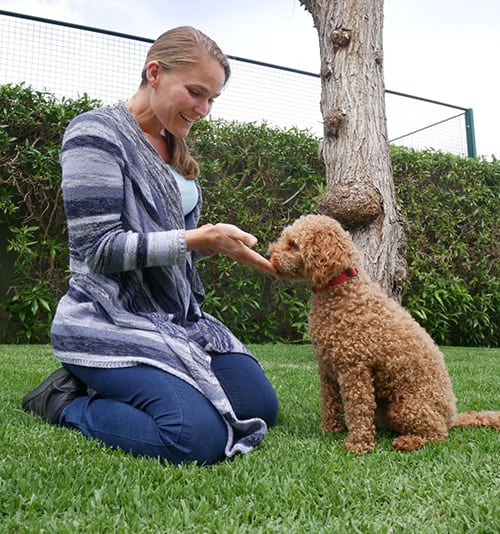
And the most important one of all is not a technique: talk less. Most of the sounds dogs make themselves mean arousal or alarm, so our voice sounds tense to them. Going quiet and making a gesture literally calms a dog down.
Six habits of an owner who speaks dog
Give support when your dog is scared. Fear is an emotion, and you cannot reward an emotion. A dog who can come to you when he is frightened will do exactly that, instead of looking for his own way out.
Do not be bossy. See above. A dog needs a predictable, calm adult, not an alpha.
Use his natural politeness. Walk a curve around unfamiliar dogs and people. Your dog notices that he can go around, and does not need to bark.
Ask permission before touching. Pet for a moment, stop, take your hands away. If he comes back, you may continue. If he stays put or walks off, that was enough. Pet under the chin or on the chest, not over the head.
Let him think instead of running laps. Sniffing, searching for treats and chewing are satisfying and produce calming hormones. Throwing a ball mostly builds stamina and stress hormones.
Do not be a bully. A poke, a leash jerk, shouting, a choke chain: that is not training, that is bullying, and you cannot trust a bully. For every problem there is a solution without pain, fear or force.
From our practice
More than 30,000 dog parents have taken a Stressless Dogs course by now, and more than 96,000 watched the free webinar that comes before it. What they write back to us is rarely about tricks and almost always about understanding. Karin B. wrote on Trustpilot (July 26, 2026, 5 stars): “The focus on the differences in communication really speaks to me and has been very useful. I understand my dogs better and I can guide them better.”
And P. S. wrote on Trustpilot (April 15, 2026, 5 stars): “The methods that were shown taught us a lot about how dogs communicate, and that we do not have to be afraid of a confrontation at all when we are walking in the woods, for example. Visitors coming over is also much calmer now, for both owner and companion.”
When to get help
Is your dog biting, is he snapping at people, or is a fear getting worse week by week? Then this is not an article to practice with: bring in a qualified, welfare-focused behavior consultant. If your dog’s behavior changes suddenly, start with your veterinarian, because dogs hide pain by nature.
Frequently asked questions
Can I really learn dog language, or is that something for trainers?
Anyone can learn it; compare it to a foreign language. You will see the first signals (lip licking, yawning, looking away, slowing down) in your own dog after a week of watching on purpose.
My dog looks away when I call him. Is he ignoring me?
No. In dog language, looking straight at someone is confrontational; looking away is respect and a calming signal. Do not look at him too long either, and turn slightly away.
My dog wags his tail at everyone. That means he is happy, right?
Wagging means arousal, positive or negative. Look at the rest of the body: loose movements and a soft mouth are relaxation; a stiff body, whale eye and shrill barking are tension. More on that in What does it mean when a dog wags its tail?
Where do I start?
With one signal: the lip lick. Count for a week how often you see it and in which situations. Then move on to yawns. The patterns will show themselves.
Sources
Rugaas, T. (2005). On Talking Terms With Dogs: Calming Signals (2nd edition). Dogwise Publishing.
Mech, L.D. (1999). Alpha status, dominance, and division of labor in wolf packs. Canadian Journal of Zoology, 77, 1196-1203. The paper in which the researcher himself steps away from the alpha idea.
American Kennel Club. Dog Body Language.
Read next
You learn a language by listening
Everything in this article starts with watching. Not to correct your dog, but to hear what he has been saying all along. In the free webinar you see the five signals almost everyone misses on video, at the pace of a real dog, and you learn the first technique for talking back.
Do you want to learn the whole language after that, with all six techniques and the situations from everyday life? That is the Stressless Communication Course.
Thank you for reading, on behalf of me and all the dogs.
Dog Behavior Consultant & Natural Dog Trainer