Calming Signals in Dogs: How Your Dog Defuses Tension and What You Do With It

Calming signals are the good manners of the dog: more than thirty small gestures dogs use to prevent conflict and take tension away, both from themselves and from the other party. A tongue over the nose, a yawn, a head turning away, walking a curve instead of a straight line. The Norwegian trainer Turid Rugaas mapped them out and named them calming signals. What makes them special is that this is a language you can speak yourself: anyone who slows down, turns their side and does not stare too long will be understood by every dog, including one they have never met.
In short
Calming signals are behaviors that take threat away: slowing down, looking away, curving, sniffing, pausing.
They do not automatically mean stress. In relaxed situations too, dogs use them to confirm that all is well.
The difference between politeness and tension lies in the context, the repetition and the combination.
Communication escalates: dogs start quietly. Growling never comes out of nowhere; we simply miss the signals before it.
You can use them yourself: slow down, show your side, look away, walk a curve, do not stare too long.
Would you rather see the signals on video than in a list? Watch the free webinar.
What calming signals are
Dogs will always try to avoid conflict and reduce tension. Fighting is expensive, so politeness is the default. Calming signals are the way a dog says: “I am not looking for a fight”, “I need a little space” or “easy now, I have got this”. They are used mostly during interaction, with other dogs and with us.
Important: they are not only a sign of tension. You see them in relaxed situations as well, as confirmation that everything is fine. A dog who briefly looks away or sniffs during play is keeping the play enjoyable.
The signals in one list
Signal | What your dog is saying | What you do |
|---|---|---|
Lip licking (tongue briefly over the nose) | “This is a bit much right now.” The most common and most missed signal. | Note it. Several times in a row: make space. |
Yawning when he is not tired | “This is too much” or “I am not looking for a fight”. | Stop what you are doing, take your hands away and see if he comes back. |
Turning the head or body away, looking away | “I do not want a conflict.” | Look away yourself as well and turn slightly. |
Slowing down or standing still | “I want to look first.” Not stubbornness, but politeness. | Do not pull him along. Let him look. |
Sitting or lying down | Seeking relaxation, or, when he is staring hard, actually tension. | Look at the gaze: soft and shifting is fine, fixed is not. |
Curving (walking in an arc) | “I come in peace.” Socially skilled dogs start doing this at 65 to 100 feet (20 to 30 meters). | Take the outside curve yourself if the other party is coming straight at you. |
Suddenly sniffing the ground | “I am not focused on you”, while there is nothing to sniff. | Let him. It is politeness, not a distraction. |
Showing the side of the body | “No threat.” | Turn your own side toward an insecure dog. |
The play bow (front legs flat, rear end up) | “This is play.” | Check whether the rest of the body stays loose. |
Lifting a paw | Doubt between staying and leaving. | Make the situation easier. |
Shaking off | Shaking the tension out after a tense moment. | A good sign. Do nothing. |
In summary: the best known calming signals are lip licking, yawning without being tired, looking or turning away, slowing down or standing still, sitting or lying down, curving, suddenly sniffing, showing the side of the body, the play bow, lifting a paw and shaking off. They mean “this is a bit much right now” or “I am not looking for a fight”, and your answer is almost always the same: stop what you are doing, give space, and look away or make a curve yourself.
Politeness or stress?
Many calming signals can also be stress signals. The difference lies in three things: the context, the repetition and the combination. A yawn after waking up is a yawn. A yawn when you pick up your coat, followed by lip licking and looking away, is tension. The more signals you see at once and the stronger they are, the more urgently your dog needs space. The full build-up from green to red, with what you do in each phase, is in Signs of stress in dogs.
What you do with them
1. Respond to them. A calming signal is a question. If your dog turns his head away while you are petting him, stop and see if he comes back. If he slows down when a dog approaches, do not pull him along but let him look. If he yawns during a hug, the hug is for you, not for him.
2. Be polite yourself. We walk straight at dogs, we stare, we reach over their heads and we talk. In dog language that is rude. Approach a dog in a curve, turn your side, keep your hands to yourself, kneel or crouch, and pet under the chin or on the chest instead of over the head.
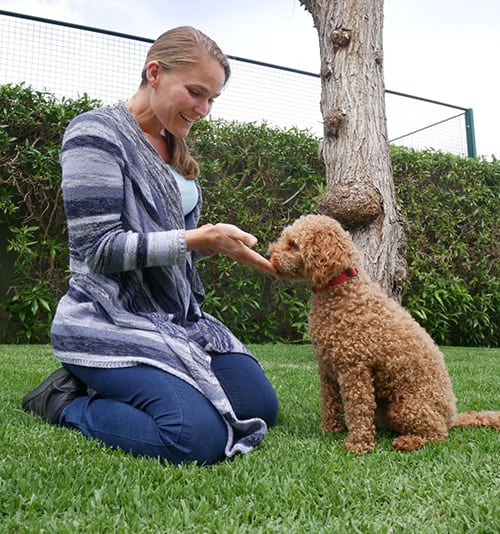
3. Use the signals yourself. You can speak exactly the same language: slow down, stand still, show your side, look away, walk a curve, do not stare too long. If your dog locks onto another dog with a fixed stare, calmly step in between him and the other dog, with your side toward your dog and without saying anything. Dogs do this for each other too; we call it splitting. Do it before the reaction starts, not after. And if you remember one tool: a low, open hand with the palm toward your dog, without eye contact. It is a scaled-down version of stepping in between, and it means “I am handling this”.
4. Talk less. Talking is the tool a dog understands least. Most of the sounds dogs make themselves mean arousal or alarm, so our voice sounds tense to them. Going quiet and making a gesture literally calms a dog down.
Calming signals during play
You recognize good play by loose bodies, plenty of calming signals, pauses, dogs adjusting to each other, and role reversal. Growling and mouthing belong to it, as long as the jaws and the head stay relaxed. It becomes worrying with tight facial muscles, hard eyes, a stiff upright body, no pauses and no role reversal. Step in at the first signs that it is tipping over, not once it has already gone wrong. More about meetings and friendships is in How to socialize a dog: why friendships work better than the dog park.
From our practice
Elke H. wrote on Trustpilot (May 12, 2026, 5 stars): “What a world has opened up! I never knew the world of dogs, including their language, was this polite and this varied. […] you can put everything into practice straight away and you notice the change in your dog straight away.”
And Mrs J. (June 27, 2026, 5 stars) compared it to learning a language: “This is a bit like learning Russian. You can simply see that the dog understands you better because you understand her better. Truly wonderful. Especially with an anxious puppy, I saw the trust grow quickly.”
When to get help
When calming signals are not heard, a dog gets louder: showing teeth, growling, snapping, lunging. Those are distance increasing signals and you always respect them: stop what you are doing and increase the distance. If your dog bites, or shows real aggression, this is not an article to practice with: bring in a qualified behavior consultant.
Frequently asked questions
My dog yawns when I hug him. Is he tired?
Probably not. A yawn during a hug is a calming signal: he finds it tense or too much. Stop for a moment, take your hands away and see if he comes back. If he does not, that was enough. You can read more in Why does my dog yawn so much?
He suddenly sniffs the ground when a dog approaches. Is he ignoring that dog?
No, he is being polite. Sniffing and looking away tell the other dog: “I am not looking for a fight”. Let him, and make a curve yourself if the other party is coming straight at you.
He looks away when I talk to him. Is he ignoring me?
No. In dog language, looking straight at someone is confrontational; looking away is respect. Do not look at him too long either, and turn slightly away, and he will come to you more easily.
Can I really use the signals myself?
Yes, and it works surprisingly well. Slowing down, standing still, showing your side and looking away are understood by every dog, including one who does not know you.
Sources
Rugaas, T. (2005). On Talking Terms With Dogs: Calming Signals (2nd edition). Dogwise Publishing. The book in which the calming signals were first described systematically.
Read next
A language you can speak back
The beautiful thing about calming signals is that they work in both directions. The moment you see them, you understand your dog. The moment you use them yourself, your dog understands you. In the free webinar you practice the first part: recognizing the signals on video, at the pace of a real dog.
The second part, the whole toolkit of curving, splitting, the hand signal and the attention signal, is what you learn in the Stressless Communication Course.
Everything we teach sits in one place: you can find all of our courses and the community there, and the free webinar is the easiest way in.
Thank you for reading, on behalf of me and all the dogs.
Dog Behavior Consultant & Natural Dog Trainer