Dog adolescence: what changes and how you get through it together

Adolescence in dogs starts at around six months and lasts until roughly eighteen to twenty-four months. The puppy who did everything so well suddenly listens less, gets aroused faster, acts on impulse, and is sometimes frightened of things he already knew. That is not disobedience but hormones and a brain under construction: in male dogs, testosterone peaks at up to seven times the level of an adult male, female dogs come into heat for the first time, and in between there are a few fear periods. Just like with people, it is a difficult stretch, for the dog and for the person. And just like with people, it passes.
In short
Adolescence: from about 6 months to 18 to 24 months. The first signs of pulling away often show from 9 months on.
Male dog: a testosterone peak that raises impulsivity and arousal and lowers self control. Female dog: a first heat between 6 and 18 months.
Fear periods between 8 and 9 months, between 13 and 14 months and sometimes around 18 months are normal and healthy.
Punishment makes it worse. Management, rest and small steps help.
Social contact with other dogs is usually the hardest part for adolescents. Choose quality over quantity.
An adolescent who “will not listen” showed you seconds earlier that his bucket was full. Learn to see that in the free webinar.
The timeline
Age | What happens | What helps |
|---|---|---|
From about 4.5 months | Growth spurt: the body grows unevenly, he can stand crooked and become insecure; risk of growing pains | Shorter walks, fewer exercises, no slippery floors or jumping |
Around 6 months | Adolescence begins; in male dogs testosterone starts to rise | Predictable routines, plenty of rest |
6 to 18 months | First heat in female dogs: withdrawing, moody, less able to concentrate | Keep her on leash for the whole heat; see A dog in heat: how her behavior changes |
8 to 9 months | Fear period: suddenly afraid of the trash can that has stood there for months | Introduce nothing new, offer support, do not lure |
From about 9 months | Pulling away from his caregivers: more independence, less response to his name | Long line instead of off leash, keep rewarding coming back |
13 to 14 months | Second fear period of adolescence | Rest, successful experiences, no forcing |
Around 18 months | Sometimes one more fear period; testosterone drops toward adult level | Patience; what you guide well now will pass |
18 to 24 months | End of adolescence; the skeleton is fully grown at around 24 months | Social skills keep developing until three or four years of age |
In summary: adolescence starts around six months and ends between 18 and 24 months, with a growth spurt from 4.5 months, a first heat in female dogs between 6 and 18 months, a fear period around 8 to 9 months and again around 13 to 14 and sometimes 18 months, and from 9 months on the pulling away from caregivers. What helps is rest, predictable routines, forcing nothing new, and a long line instead of off leash freedom.
What is happening in his body
In male dogs, testosterone during adolescence peaks at up to seven times the level of an adult male. The result: more impulsivity, higher arousal and reduced self control. Your adolescent spots another dog and is gone before his brain has had a chance to think. During this period, avoid high risk situations so you prevent conflicts he will remember for a long time. In female dogs the first heat usually comes between six and eighteen months; keep her on leash for the entire heat.
This is worth remembering: arousal and stress are hormonally the same thing. An adolescent who “goes completely wild” at the sight of another dog is not being cheerfully disobedient, he is over his threshold. At that moment the thinking part of his brain is switched off, he cannot learn anything, and he will not even take his favorite treat. That is not stubbornness. The situation is too hard.
The fear periods in adolescence
Every puppy goes through fear periods, and they are normal and healthy. Fear shows itself through the four F’s: fight, flight, fiddle and freeze. Fighting, running away, acting silly or shutting down. This is how you guide a dog through a fear period:
Take your time and offer support, calm and safety. You cannot reinforce fear.
Introduce nothing new and do not lure your dog toward the scary thing. Luring with food is a form of forcing.
Let your dog choose whether and when he approaches something.
Do not get angry or impatient, and invest in successful experiences.
What you guide well now will pass. What you force or punish can stick around. All the fear periods in one place, from 8 weeks to 18 months, are in Fear periods in dogs: when do they happen and what do you do?
“He suddenly stopped listening”: what is really going on
This is the complaint we hear most often about adolescents. Three things are happening at once: the pulling away from caregivers, the reduced self control caused by hormones, and the simple fact that an aroused brain is not reachable. Your dog is not doing it on purpose, and he has not become dominant.
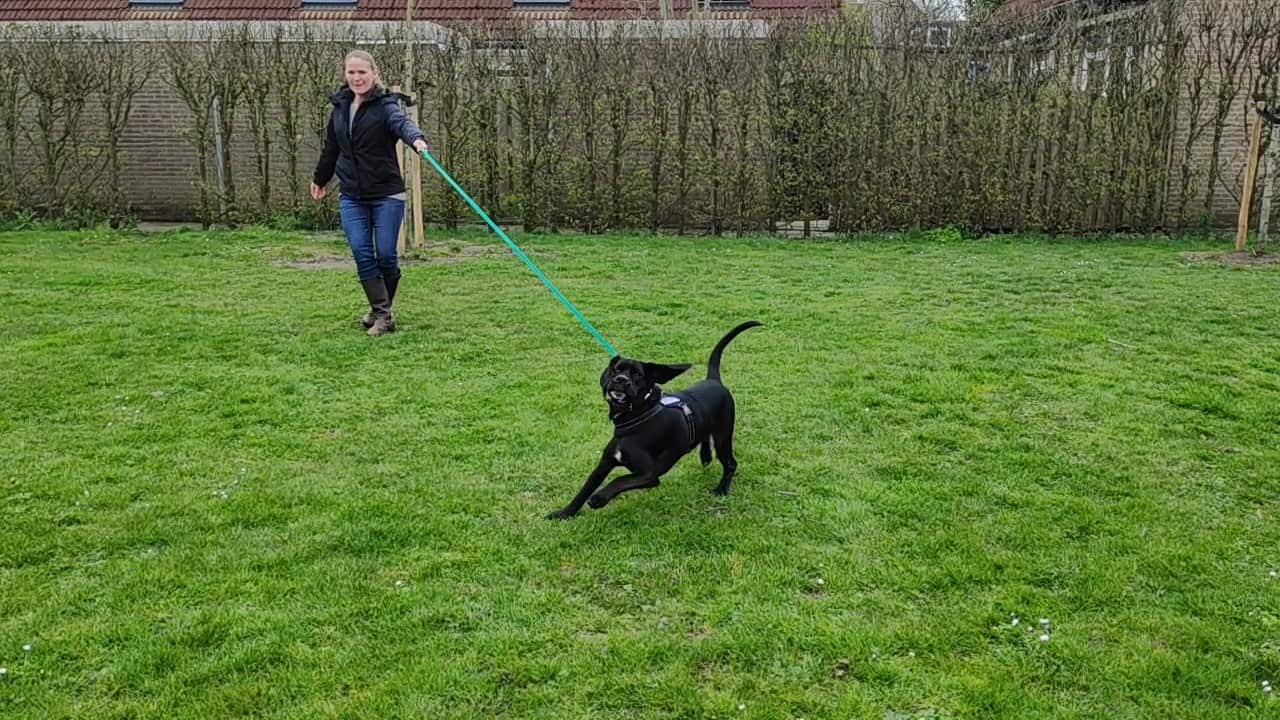
What helps:
Management. A long line instead of off leash freedom, so your dog has room and you have safety. Do not call him if you know he will not come; every failed recall weakens the word.
Keep rewarding coming back. Your dog always gives something up to come to you. Call in a friendly tone, even when you are annoyed, and do not clip the leash on every single time, or coming back starts to feel like punishment.
Choose your moments. Train short and easy, at times when he is calm. In a busy place full of other dogs, an adolescent learns nothing.
Stop it from becoming a habit. A temporary phase passes on its own, but behavior that is rehearsed for months gets worn in. Every outburst you prevent is one your dog does not practice.
How to help your adolescent through it
Rest and sleep. An adolescent still needs far more rest than you think. Too little sleep means more stress, and more stress means less self control.
At most one impressive activity a day, with quiet days in between. The adolescent brain processes slowly.
Social contact with a plan. For adolescents this is usually the hardest part. Avoid crowded off leash parks and groups of unfamiliar dogs; there he learns that other dogs are wild and pushy, or he copies it. Find a few stable, familiar dog friends and keep meetings short. If he lunges at other dogs on leash, read Why does my dog lunge at other dogs?
Predictability and kind boundaries. Fixed routines, and setting a boundary well before your own limit is reached: preventing, stepping in between, clipping on the leash, offering something else to do. The friendlier you do that, the more reliable you are.
Calming activities. Sniffing, chewing, treasure hunts. No endless ball throwing: that feeds exactly the arousal you want to bring down.
Never punish. A correction adds stress to a brain that is already full, and it damages the bond in precisely the phase where your dog is pulling away from you. How to redirect behavior instead is in Training a puppy without punishment.
From our practice
Marleen B. wrote on Trustpilot (June 30, 2026, 5 stars): “We have a young dog of 9 months! Stressless Dogs gives you real insight into dog language! Thanks to the course you learn to understand your dog much better, you understand your dog’s behavior much better.”
Nine months is exactly the moment when the pulling away begins, and when understanding matters more than obedience.
When to get help
Is your adolescent becoming genuinely aggressive, is he biting, or does a fear hang around for weeks and only get worse? Then have a welfare oriented behavior professional take a look. If his behavior changes suddenly and dramatically, or he moves stiffly or limps, see your veterinarian first: growing pains and other pain make an adolescent quicker to react, and a veterinarian is not a behavior specialist, so keep asking questions.
Frequently asked questions
Does my dog become dominant during adolescence?
No. Dominance as an explanation for dog behavior comes from outdated research on captive wolves; the researcher who popularized the term, David Mech, distanced himself from it in 1999. What you are seeing is hormones, pulling away, and a brain that is not finished yet.
Should I have him neutered to calm things down?
That is a medical and individual decision to discuss with your veterinarian. In our course we look at behavior, stress and guidance, not at surgery.
How long does adolescence last?
Until about eighteen to twenty-four months, with big differences between individual dogs. It passes, and the trust you build in this period is yours to keep.
Can my adolescent still run off leash?
A long line is better. Off leash you have very little control at the moment his self control gives out. You give freedom with a 33 foot (10 meter) line in a quiet area, and you keep rewarding him for coming back.
Sources
Mech, L.D. (1999). Alpha status, dominance, and division of labor in wolf packs. Canadian Journal of Zoology, 77, 1196-1203.
Read next
Fear periods in dogs: when do they happen and what do you do?
Training a puppy without punishment: the four ways to redirect behavior
How to socialize a dog: why friendships work better than the dog park
Your adolescent tells you where his limit is
An adolescent who stares, freezes, starts pulling harder or suddenly yawns is showing you that his bucket is nearly full, often seconds before he “stops listening”. Once you learn to read those signals, you can step in before the brain switches off. In our free webinar on communicating with your dog you see that tipping point on video, and you learn a technique to reach your dog without calling him.
Do you want to be guided step by step through the fear periods and the hormonal ups and downs, starting with the language your dog is already using? That is the Stressless Communication Course.
Thank you for reading, on behalf of me and all the dogs.
Dog Behavior Consultant & Natural Dog Trainer